The Referee

By the time the sheriff called, Diane had already decided she wasn’t going up a day early this year.
She was sitting at her kitchen table under the glare of the overhead light, sorting coupons she was never going to use and circling things in the grocery store flyer out of habit. Turkey breasts were on sale. Not whole turkeys— just the breasts. That felt like some kind of omen.
Her phone buzzed. UNKNOWN CALLER. She almost let it go. Then she remembered small towns didn’t really have “unknown callers.” They had people too stubborn or distracted to put their name in.
“Hello?”
“Is this Diane Kelleher?” The voice was male, tired, with that North Country drag like every word had to be hauled uphill.
“Yeah. Who’s calling?”
“This is Sheriff Harkness. Over in West Maple. Your sister gave me your number.”
“You must be confused, she doesn’t– “ she started.
“No, ma’am.” Harkness cut in with a cordial but impatient tone. “I am calling you about your sister.”
Diane’s heart dropped to her stomach.
“Marla?” Diane said, already standing up, grabbing for the pen in the junk drawer like she’d need to write this all down. “What happened? Is she okay?”
“She’s fine. Physically, anyway.” Paper rustled on his end, like he was flipping through a thin file. “She’s here at the station. I’m gonna need you to come get her.”
Diane sat back down. “Come get her from what, exactly?”
There was a pause. In the background, she could hear a radio, somebody laughing, the clank of something metallic. Then the sheriff said. “She’s under arrest, ma’am.”
Diane snorted. “No, she isn’t.”
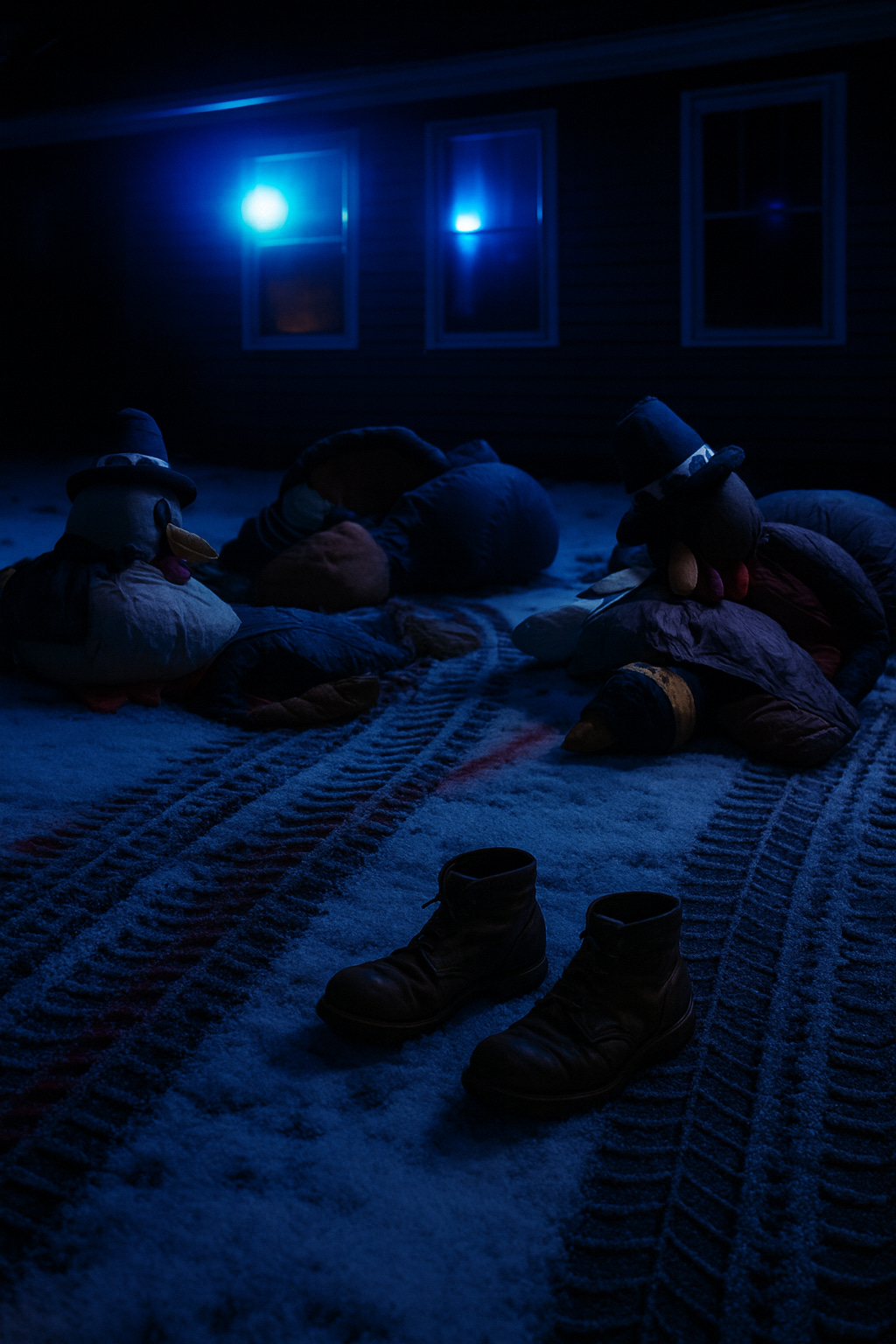
“I assure you she is. She drove the town plow into a front-yard Thanksgiving display.”
“What?” Diane pinched the bridge of her nose. “No, you have the wrong– ”
“And then,” Sheriff Harkness added, his voice flattening, “she kept going. Reversed. Forward. Reversed again. On purpose. On camera. There’s… considerable damage.”
The image landed fully formed: Marla, in her good parka, jaw set, hands at ten and two, just absolutely annihilating one of those inflatable turkey pilgrim scenes with the manic righteousness of a woman who’d had to see one too many of them on Facebook.
“Jesus Christ,” Diane said softly.
“Yes, ma’am,” the sheriff replied. “I imagine he’s involved somehow.”
*********************************************************************************
West Maple’s sheriff’s office was attached to the same brick building as the town clerk and the assessor. The whole place smelled faintly of wet wool and copier toner. Bob Harkness had the build of a man whose metabolism had given up sometime around 1998 and a face that always looked like he’d just walked into a conversation he didn’t want to be in. His expression matched his buzzcut and a Movember mustache. He met Diane at the secure door, paper cup in hand, shirt untucked from one side of his belt.
“Evening,” he said. “Happy almost Thanksgiving.”
“Coulda fooled me,” she said. “What the hell happened?”
He winced. “Well. Your sister’s um… incident…started with the town plow and a twelve-foot inflatable turkey. And one of her neighbors.”
Diane stared. “In what order?”
“That’s what we’re still sorting out.”
The Sheriff turned and flailed an arm behind him. “Right this way, please.”
Diane stomped the slush off her boots and followed him down a short hallway. They stopped at a room with a door that creaked as he pushed it open. The office had the usual sad décor: a faded flag, a corkboard with memos curling at the edges, a framed photo of a Little League team from some bygone year. On the desk: a paper plate with the remains of a muffin and a mug that said WORLD’S OKAYEST COP.
Diane almost laughed. Almost.
Marla sat on a plastic chair, hands folded in her lap like she was waiting for a dentist. Sixty-two, silver at her temples, hair cut in a bob that said I have opinions about school board budgets. Diane had never seen her look small before. Now she did.
“Di,” Marla said, standing up. “I’m so, so–”
“What the hell,” Diane said, more evenly than she felt, “did you do?”
Marla dropped her eyes to the floor, her shoulders fell in a slump forward.
Sheriff Harkness sat, then pointed at the two chairs across from him. “Have a seat, ladies.” They sat. Marla’s face beet red with shame, Diane’s pinched into distress.
The Sheriff rubbed a hand over his face like it physically hurt him to keep it attached. “All right,” he said, pointing two fingers at Marlene like he was choosing her in a lineup. “Listen. I understand you were overwhelmed in a moment of, let’s call it passion so I’m willing to go a little easier on you than some degenerate, but, you are not off the hook.”
Marlene swallowed.
“The plow is city property,” Harkness continued. “The snowblower thing sticking out the front? Also city property. The mailbox you shaved off? Private property but they’re already mad about it. And the… situation… involving Mr. Gerald Laramie. ”
Diane frowned. “Wait– Laramie? The lawyer? On the corner?”
“That’s the one.”
Diane’s eye brows shot up. “Oh my god! Mar–”
“I didn’t hit him on purpose,” Marlene blurted.
“Nobody thinks you meant to,” Harkness said. “But intention doesn’t un-dent a plow, and intention sure as hell doesn’t un-break his pelvis.”
Diane muttered, “I told you not to get riled about those inflatable turkeys.”
Harkness held up a hand. “Not my business why she did it. I don’t have the bandwidth to unpack that. What is my business is that the town budget is running on fumes, and I do not have time to sort through the paperwork for this mess.”
He cleared his throat and looked at a report. “So. Short version. Your sister took the town plow–”
“I had permission,” Marla cut in. “From the DPW. I’ve been subbing mornings when they’re short.”
“She took the town plow,” he repeated, “down Route 12. She then proceeded to drive that plow through Mr. Laramie’s front-yard holiday display.”
Marla exhaled hard through her nose. “He had eight of them, Di. Eight. Thanksgiving turkeys. Pilgrims. A football player. A–” she paused, shaking her head in tiny, aggravated jolts. “ A giant pumpkin in a pilgrim hat. It looked like a cult meeting. It’s November, not a– a yard sale at Hell’s Party City. Kids have to ride past that on the bus.”
Diane stared at her. “So you… killed his decorations.”
“And his mailbox,” the sheriff said. “And two rose bushes. And… and a decorative boulder, which I’ll be honest, I did not know you could kill, but you did significant damage.”
“It was an eyesore,” Marla muttered.
“Marla,” Diane said.
Sheriff Harkness scratched his temple. “Now, ordinarily, that’s bad enough. Property damage. Vandalism. But we have a complication.”
Diane felt the bottom drop out a little more. “What kind of complication?”
The sheriff folded his hands. “We got a call about thirty minutes after the incident from the ER in Pine Bay. A man came in with internal injuries. Said he’d been out checking his electrical connections on his own inflatables. Different place, up by the four corners. When the plow came through the edge of his yard and… well.” He glanced at the report. “In their words, ‘it went through him clean.’ Clip, really. Knocked him into his own snowbank. Didn’t even slow down. They thought he’d be okay. He’s not.”
Diane felt suddenly aware of her heartbeat. “Is he– ?”
“He died on the table.” Harkness’s jaw flexed. “His name was Glen Harrow. Forty-eight. The guy with all the Thanksgiving blow-ups by the old gas station.”
Diane closed her eye and let her head drop into her hands. The image of that yard, a churning sea of nylon and LEDs, every square inch of grass covered with grinning, cartoon pilgrims and turkeys, blown up huge against a November sky the color of dishwater. She’d seen it on the drive up last year, had reflexively muttered, “Christ almighty,” under her breath. Diane wasn’t the biggest fan of it either, but, a plow?
Diane turned in her chair to face Marla. “I honestly don’t know what to say.”
Marla’s hands were clasped so tightly in her lap, her knuckles were white. “I didn’t see him,” she whispered. “Diane, I swear to God, I didn’t. I thought it was just the corner of his yard. Just the turkeys. I stayed in the road. Mostly.”
Diane swallowed. “Mostly?”
“The roads are narrow,” Marla said, desperate. “There’s nowhere to put the snow anymore. People stick those damn things right up against the shoulder. It’s like driving through a parade nobody asked for. He shouldn’t have been out there. Not when the plow’s coming. There were flashing lights.”
He looked between them, then sighed so deeply it came from the bottom of his soul.
“Ms. Kelleher,” Sheriff Harkness said, shifting his gaze to Diane, “I want to be very clear. We’re still investigating. There’s road conditions, visibility, prior complaints, all that. And the DA’s away hunting this weekend. Marla, You are not being charged with anything connected to Mr. Harrow’s death. Not today. I’m not processing anything until after Thanksgiving.”
Marla blinked. “Wait– you’re… delaying my charges?”
“Yes,” Harkness said flatly. “Because quite frankly, ladies, my wife has been brining a turkey since Monday. My kids are home from college. I’ve got two pies cooling in the truck because I forgot them in the break room, and if I don’t leave in the next five minutes, I’m going to be late to my own table.”
He jabbed a pen at Marla.
“But don’t misunderstand me. You will be paying for the plow repairs. And the mailbox. And probably Gerald’s physical therapy unless he decides to forgive you, which, I’ll be honest, seems unlikely.”
“Okay,” Diane said slowly. “So… what is she being charged with, when it’s, you know, time?”
He sighed. “Criminal mischief. Destruction of property. Reckless operation. You can bail her out today. Judges are all home making pies, so we’ll do a personal recognizance and let her go on your say-so.”
He looked at Marla again, and some of the irritation leaked out of his expression, replaced by something older and more tired.
“Look,” he said, “You caused a hell of a mess. There’ll be reports, insurance, probably some kind of hearing once the DA’s back and the state finishes whatever it’s gonna finish. You’re gonna have to answer for it. And pay for at least the mailbox.”
Marla nodded, eyes glassy.
“But.” He leaned back, chair creaking. “The only thing I wanna do less than have this conversation right now is explain to them why I missed my mother-in-law’s green bean casserole because I was at the office talking about homicidal yard art. You follow me?”
“Yes, sir,” Marla said faintly. “So we can… go?”
“For now.” He pushed the paperwork toward Diane. “You take her home. You keep her away from any and all motorized vehicles and inflatable pilgrims. We’ll pick this back up next week, when I’ve had some pie and a nap and a long, long talk with my insurance guy.”
Diane picked up the pen. Her hand shook a little. She signed anyway.
He waved them off. “Go home. Cook something. Don’t hit anyone else with municipal equipment. And for the love of God, stay away from holiday inflatables.”
As they shuffled out, he added, “I swear, every damn year someone loses their mind over those stupid things… but you’re the first one who’s weaponized a plow.”
***********************************************************************************************************
The drive back to Marla’s house was quiet for six full minutes. That had to be some kind of record.
Snowbanks hunched on either side of the narrow road, already gray at the edges from sand and exhaust. Yards flickered past: bare trees, sagging porches, a few defiant orange pumpkins gone soft at the seams. And, of course, here and there, the gleaming nylon armies.
A gigantic turkey in a pilgrim hat loomed over one driveway, wings spread in eternal welcome. Across from it, a smiling cornucopia spilled cartoon produce onto the snow.
Diane glanced at Marla. She could see the twitch at the corner of her eye.
“How long has this been going on?” Diane asked finally.
Marla stared straight ahead. “Since last year.”
“The plowing? I thought you were just doing mornings this month.”
“The… thinking about it.” Marla’s fingers tightened on the steering wheel. She was driving slow, well under the limit, like penance. “It started as a joke. I’d drive by and think, ‘Somebody should take a pin to those ugly things.’ Then Laramie added a turkey every week. I counted. Then he put a generator hum right under my living room window. It was like living inside a parade float. And everybody kept posting them online like it was cute. Like that’s what holidays are now. Giant plastic cartoons screaming joy at you while the planet burns.”
Diane almost smiled. “You sound like Dad.”
“Dad hated the blow-molds,” Marla said. “At least those were solid. These things…” She shook her head. “They’re hollow, Di. Just a bunch of loud air. It’s like– ” She stopped, searching for the word. “It’s like we’ve decided holidays are all display and no… no anything.”
“Substance,” Diane supplied.
“Substance. Yeah. We’re all out there screaming THANKFUL BLESSINGS at each other with a twelve-foot turkey on the lawn, and nobody can stand to be in the same room long enough to eat the damn meal.”
Diane thought about her own kids, who texted from rooms away, who came home for Thanksgiving but left their earbuds in during grace. She thought about the year she and Marla had fought in Mom’s kitchen over who got to baste the bird, and Tommy had gone outside to smoke in the driveway until the shouting stopped.
“You could have just… written a strongly worded letter,” Diane said.
Marla huffed. “To who? The HOA? There isn’t one. Besides, I didn’t mean to– “ Her voice cracked, and she swallowed it down. “I just wanted to scare him a little. Take out a pilgrim or two. You know he had one dressed like a referee? For football? What does that even mean?”
Diane didn’t answer. Up ahead, she could see the flashing tape around Glen Harrow’s yard, the dark smear in the snow where the plow had clipped too close. The inflatables were down now, deflated heaps of nylon, sagging like the aftermath of a failed party.
They looked smaller this way. Sad, even.
Marla slowed as they passed. Diane watched her sister’s face for… something. Horror. Gratitude. Shame.
What she saw was worse: recognition. The look of someone finally seeing the shape of what she’d done, and realizing it fit too neatly into the outline of a thought she’d been nursing for months.
“I didn’t want him dead,” Marla whispered.
“I know,” Diane said. She didn’t add, I think. She let the heater hum fill the silence instead.
******************************************************************************************************
The next morning, Diane woke on the pullout couch in Marla’s den to the smell of onions sautéing and the faint, arrhythmic clink of a spoon against a pot. For a moment she could pretend this was any other Thanksgiving. Then her phone buzzed with a news alert:
LOCAL MAN’S DEATH LINKED TO PLOW INCIDENT; INVESTIGATION CONTINUES
She clicked the screen off without reading.
In the kitchen, Marla stood at the stove in an old sweatshirt, hair clipped back, stirring something that was trying very hard to burn.
“You’re using too high a heat,” Diane said.
Marla didn’t look at her. “I like to live dangerously.”
There it was– the old Marla, the one who cracked jokes at funerals. Diane let out a breath she hadn’t realized she was holding.
“You hear from the kids?” Marla asked.
“Yeah. Emma and Josh’ll be here by noon. They’re bringing pie. From a bakery, not homemade. I’ve decided not to take offense.”
“Progress,” Marla said. Then, after a beat: “I’m making the sweet potatoes with the marshmallows. Figured if I’m going to hell for manslaughter, might as well take my arteries with me.”
“Too soon,” Diane said automatically. Then, “But I’ll eat them.”
They worked in uneasy tandem for a while. Peel, chop, stir, season. There was something soothing about it, like following a ritual older than their particular disaster.
Around ten, the doorbell rang.
“Oh God,” Marla said, wiping her hands on a dish towel. “If that’s the sheriff, I’m jumping out the back window.”
“It’s probably FedEx.” Diane moved toward the front hall. “Or the neighbor with a casserole. People love tragedy if they can drop something off and feel helpful.”
It was neither. When she opened the door, she found a kid of about twenty standing on the porch, cheeks reddened from the cold. He wore a Carhartt jacket and the haunted look of someone who’d had to rehearse a speech three times before knocking.
“Can I help you?” Diane asked.
“Uh. Hi. I’m– I’m Ryan. Glen’s nephew? They asked me to drop this off.” He held up a plastic grocery bag, the kind that never fully unwrinkles. Inside, Diane could see a folded tarp and something orange.
Marla appeared at her shoulder. She froze when she saw the bag.
Ryan swallowed. “We’re, uh, taking everything down. My aunt said your sister… that she–” He stopped, clearly searching for the least terrible version of the sentence. “Anyway. Glen always said if he ever got himself killed doing something stupid, we should make sure the person who helped him along the way didn’t forget him.”
Diane frowned. “What is it?”
He handed over the bag. Diane could feel the cold of it through the plastic. “It’s one of the turkeys,” he said. “The referee one. He… he really loved that one. Said it made no sense.” For the first time, his mouth twitched in something like a smile. “He’d probably think this whole thing was funny, eventually. After he was done yelling.”
“I’m so sorry for your loss,” Marla said, voice hoarse.
Ryan nodded, eyes shiny. “Yeah. Me too.” He shoved his hands back in his pockets like if he didn’t, they’d do something stupid, like reach out. “Happy Thanksgiving, I guess.”
“Yeah,” Diane said softly. “You too.”
She closed the door. They stood in the hall, staring at the bag.
“Jesus,” Marla said finally. “A parting gift.”
“Maybe it’s… forgiveness,” Diane offered.
Marla snorted. “Feels more like evidence.”
They opened it at the kitchen table. The inflatable turkey flopped out in a tangle of vinyl and stitched-on righteousness, the little black-and-white-striped shirt wrinkled but intact. The face was joyfully blank, mid-gobble.
Marla stared down at it. Her jaw worked.
“You could throw it out,” Diane said. “No one would blame you.”
Marla shook her head slowly. “No. That’s not– no.” She looked up, eyes wet but clear. “You know what I’m gonna do?”
“Burn it?” Diane guessed.
“Put it up,” Marla said.
Diane blinked. “You’re kidding.”
“I’m not.” Marla wiped at her face with the heel of her hand. “I’m gonna put it up in the yard every year. Just that one. No pilgrims. No football player. Just the stupid ref turkey. And every time I do, I’m gonna remember that Glen Harrow died because he loved something stupid enough to stand in the snow and fuss with it while a plow was coming. And because I hated something stupid enough to think scaring him would fix anything.”
Diane studied her. It wasn’t absolution. But it was something like a sentence.
“You’re going to be the lady with the turkey,” she said. “You realize that.”
Marla gave a cracked, almost-laugh. “Could be worse. Could be the lady in county.”
Outside, a car door slammed. Emma and Josh arriving, shouting something about traffic. The day moved forward, as days insisted on doing. There would be turkey and sweet potatoes with marshmallows and jokes that landed wrong and a brief, awkward moment when the news came on and everybody pretended not to look at Marla.
Later, after dishes, after pie, Diane found herself at the front window, looking out at the yard. The snow had started again, small and steady. In the dim porch light, she could see Marla out by the shed, the plastic bundle of the ref turkey tucked under her arm like a baby.
She watched her sister cross the yard, pick a spot near the road, and kneel in the snow. She couldn’t hear the words from inside, but she could see Marla’s lips moving as she worked– whether a prayer or an apology, Diane didn’t know.
She only knew that when the thing finally inflated, wobbling up into shape, its ridiculous whistle clamped in its vinyl beak, she didn’t hate it.
It stood there, lit from within, ridiculous and bright against the gray.
A marker. A warning. A promise.
Diane raised a hand from the window in a small, private salute, to the turkey, to Glen, to the whole messy, hollow, overinflated, grief-struck business of loving dumb things in a dumb world.
Behind her, in the kitchen, she could hear the TV in the other room, the murmur of voices, the clatter of someone going back for one more slice of pie. Ordinary sounds. Life, refusing to deflate.
“Happy Thanksgiving,” she said, to no one in particular.
The turkey just grinned back at her, dumb and unwavering, as the snow started to fall in earnest.